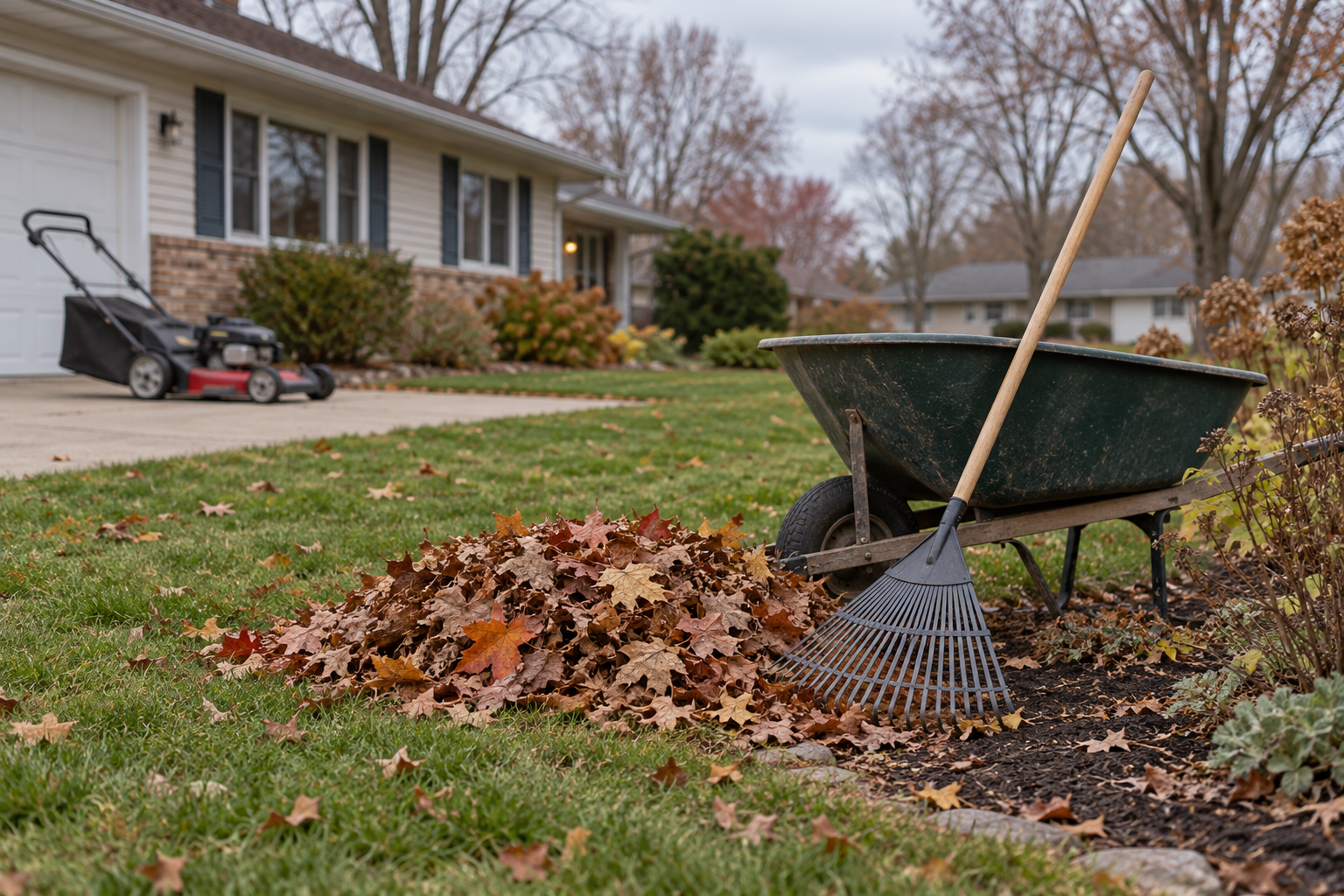
A useful Wisconsin fall lawn-care checklist starts with leaves and growth, not a shopping list of treatments. Keep heavy leaf cover off the grass, mow only while the lawn still needs it, and match fertilizer and repairs to the remaining growing season. By mid-October, ordinary seeding and an extra nitrogen feeding are usually poor choices for a typical home lawn, even though early fall is excellent timing for many turf projects.
UW–Madison Extension's guidance on October lawn care practices makes the distinction clearly: low and most medium-maintenance lawns should avoid fertilizer in October, and ordinary overseeding is risky because seedlings need enough time before hard freezes. The checklist below separates necessary maintenance from optional work, so you finish fall without paying for services the lawn cannot use.
The short version: what is worth doing now
- Remove or mulch leaves before they form a heavy, persistent mat.
- Check grass height and growth before deciding to mow again.
- Do not mow wet or frost-covered turf.
- Review what the lawn was already fed this year before buying anything.
- Consider core aeration only where a real soil problem and workable moisture justify it.
- Do not force ordinary seeding into a closing establishment window.
- Identify weeds before using any labeled, targeted treatment.
- Keep sidewalks, storm inlets, and equipment access clear.
- Store equipment and confirm winter service coverage before conditions turn difficult.
If your main constraint is time or lifting ability, start with the work that prevents smothered grass and unsafe walking routes. Our fall cleanup service cost guide separates leaf removal from a broader cleanup package, which matters when you compare quotes.
Match the work to what you actually see
| What you observe | Do now | Defer or reassess |
|---|---|---|
| Light scattered leaves, active growth | Mow as needed; shred manageable leaves into the turf | Extra mowing just because it is the weekend |
| Heavy, wet leaf cover in shaded areas | Remove excess in repeated, manageable rounds | Grinding a dense mat into the turf again and again |
| Compacted or thatchy soil, active turf, moist ground | Evaluate core aeration | Working saturated or frozen soil |
| Lawn already fed in early fall | Review records, maintain the surface | Automatic October "winterizer" application |
| Thin turf with too little establishment time | Diagnose shade, drainage, wear, and soil | Ordinary late overseeding without a viable plan |
| Frost, frozen ground, or early snow | Protect turf from traffic; finish safe off-lawn tasks | Mowing or forcing ground treatments |
Two properties on the same street can need different work because one is shaded and wet while the other stays dry and actively growing. A calendar supplies reminders; the lawn supplies the decision.
1. Leaves: remove the mat, not every leaf
A small amount of dry leaf material can be shredded during routine mowing. UW Extension's lawn maintenance guide supports mulching fallen leaves in autumn as long as the grass blades remain roughly one to two inches above the mulched material — inspect the result instead of assuming the mower solved the problem. If grass is no longer visible through the layer, you have too much on the surface.
The stakes are real. UW Extension's article on winter leaf coverage describes an evaluation study at the OJ Noer Turfgrass Research and Education Facility that tested shredded and whole leaves at two-inch and four-inch depths over three winters. Preliminary results indicate that a two-inch layer of shredded leaves is reasonable to leave over winter, while a four-inch layer is highly likely to cause winter damage. The study is described as preliminary, so treat those depths as guardrails rather than precise targets — and never as a reason to build a thicker layer on purpose.
Leaves also interact with disease. The same article lists snow mold among winter damage concerns and notes that removing excessive debris such as leaves or straw, along with avoiding excess fall nitrogen, is commonly suggested to reduce damage.
Practical approach: rake or collect excess material, especially in shaded pockets where it stays wet, and move it to a compost area or a verified municipal or private disposal route rather than leaving a pile on healthy turf. Keep storm inlets and walking routes clear while you work. Where volume is substantial, compare repeated visits against one final removal. Our leaf removal service cost guide explains why hauling, bed cleanup, and return visits need to be specified rather than assumed.
2. Mowing: follow growth, not the calendar
Continue mowing while the grass is still growing enough to need cutting and the surface is dry and safe. Stop when it no longer needs mowing. The first frost is not a universal final-cut date, and a warm spell may restart growth while a shaded area stays too wet for equipment.
UW Extension gives a mowing range of 2½–3½ inches for Wisconsin lawns, with the lower end for higher-quality turf and the higher end for lower-input lawns. It also states the one-third rule: never remove more than one-third of the leaf tissue at a single mowing. If the lawn is 4 inches tall, the mower should be set no lower than 2½ inches. Removing more than that at once stresses the turf and opens the soil surface to weed germination.
The maintenance guide is explicit that lawns should be mowed at 2.5 to 3.5 inches right up until winter dormancy, to prevent excessively long grass from laying over and increasing snow mold risk. That is the opposite of scalping the lawn short "for winter." If the lawn is overgrown, reduce height gradually across successive cuts while respecting the one-third rule.
Sharp blades and small clippings matter more than chasing a dramatic winter height. Dull blades tear grass and leave frayed, whitish tips. Leave manageable clippings in place; clippings are mostly water and do not build thatch when the one-third rule is followed. Remove clumps that would smother turf, and keep mower tires off soft ground rather than rutting a wet lawn for a uniform look.
3. Fertilizer: read the record before the bag
Write down what the lawn already received this year, including contractor applications and combination products. A bag labeled "winterizer" is not evidence that an additional treatment is needed.
The October guidance is specific. Early September is the important nitrogen window for Wisconsin lawns. Once October arrives, the risk shifts to stimulating excessive growth that creates favorable conditions for winter problems, most notably snow mold. For low and most medium-maintenance lawns, Extension advises avoiding fertilizer in October; high-maintenance lawns could receive an early October nitrogen application. Missing an earlier date does not automatically justify a late catch-up dose.
Check nutrient needs and labels rather than assuming more potassium or phosphorus improves winter survival. Extension notes that most Wisconsin soils already contain sufficient phosphorus and potassium for established turf, and that phosphorus is not allowed to be applied unless a soil test shows the need, or the area is newly seeded or sodded. An inexpensive soil test is the honest way to decide.
Follow every label direction on any product, including application rate, protective equipment, and precautions around people, pets, and desirable plants. Do not blend leftover products or reach for a weed-and-feed bag because it seems efficient. If you compare service quotes, our Wisconsin fertilizer service cost guide helps you ask what product and timing are actually included instead of accepting a package name.
4. Aeration: do it for a reason
Core aeration can help compacted or thatchy lawns. Extension's October guidance says core aerating can still be done on lawns throughout October, and that the key to success is adequate soil moisture when the work is done. Its maintenance guide recommends aerating severely compacted or thatchy turf and ties aeration to actively growing grass.
That does not mean every yard needs annual machine work. Look for persistent compaction from traffic or soil limitations rather than a surface that simply feels firm in a dry week. If drainage is poor, separate compacted soil from a grading or water-flow problem that aeration cannot fix. Poor surface drainage is one of the soil issues aeration can improve, but it is not a substitute for correcting where water goes.
Extension also draws a useful equipment distinction: core aerators pull up small soil cores and drop them on the surface, which is better than machines that only punch holes. Rentals are widely available, or the work can be hired out. If you hire, ask whether plugs are removed or left, and whether topdressing is included.
Safety matters here more than the checklist suggests. Mark irrigation components and shallow private lines, keep heavy equipment off saturated ground, and call a pro when underground utilities, steep slopes, or unfamiliar equipment are involved. Our lawn aeration cost guide covers the scope questions worth settling before you compare quotes.
5. Seeding: be honest about the window
Ordinary seeding is the most time-sensitive fall job. Extension places ideal seeding in late August or early September, when warm soil supports quick germination, and identifies the real constraint as enough time — usually about four to six weeks — for seedling development before hard freezes. By October it calls overseeding very risky and advises delaying until the next season.
Do not scatter seed just to cross a repair off the list. Identify why the area thinned: shade, standing water, repeated traffic, or underlying soil conditions can defeat perfect timing. Photograph the area and write down what needs correcting before spring.
Dormant seeding is a different practice with its own timing, site selection, and erosion considerations — not simply late seed that you hope establishes immediately. If you do not have that plan, protecting the site and scheduling a better-timed renovation is more honest than promising spring results from a hurried application.
6. Weeds: treat what is actually growing
Identify the weed and measure how much of the lawn is affected. A few broadleaf weeds do not justify a whole-property application. Extension's October guidance supports broadleaf weed control while weeds are still actively growing, prefers liquid applications sprayed directly on target weeds over granular products, and recommends reducing the amount applied by spraying visible weeds rather than areas with no weeds.
Read and follow the label, including reseeding intervals, temperature limits, and precautions for people, pets, and desirable plants. Do not mix leftover products or double up because a spot looks stubborn. A dense, properly mowed lawn reduces weed opportunities over time; if one patch keeps failing, fixing the growing conditions is usually more durable than repeating seasonal spraying.
7. Equipment and property handoff
Walk the property once leaves are cleared. Note damaged drainage components, trip hazards, and places where snow storage would block access. Move hoses, toys, and tools before snow hides them. Do not climb onto a roof or step into traffic to finish a lawn checklist.
Before storing the mower, follow its manual for fuel or battery care, cleaning, and blade handling. Shut the equipment down and disconnect the spark plug or remove the battery key before working near blades, and wear gloves when handling a sharpened or bent blade. Fuel and battery safety deserve the same attention you give the lawn. If someone else handles winter snow removal, confirm which sidewalks, steps, and entrances are included.
Keep a short record of completed work and unresolved problems. A photo and a sentence about the wet corner will be more useful next spring than an elaborate checklist with no observations attached.
Frequently asked questions
What should I do first if I only have one afternoon?
Remove heavy leaves, clear walking routes, and mow only if growth and safe conditions justify it. Skip optional treatments until you have the records and site information to make a sound decision.
Do I need to fertilize and aerate in the same visit?
No. They address different problems and should be judged separately. A service bundle does not establish that your lawn needs both, or that today is a suitable day for either one.
Should every Wisconsin lawn be cut very short before snow?
No universal scalping recommendation is justified. Extension advises mowing at 2.5 to 3.5 inches up to dormancy, following the one-third rule. Cutting shorter than the recommended range risks stress without a proven winter benefit.
Is it too late to overseed in October?
For ordinary overseeding, Extension treats October as very risky and recommends waiting until the next season, because seedlings need roughly four to six weeks before hard freezes. Dormant seeding is a separate planned practice, not a late catch-up option.
Sources
- UW–Madison Extension: October Lawn Care Practices: timing for overseeding, nitrogen fertilization, core aeration, and broadleaf weed control. Undated seasonal guidance; no year-specific claims are made here.
- UW–Madison Extension: Lawn Maintenance: mowing height and the one-third rule, leaf mulching, phosphorus and potassium guidance, aeration, and snow mold notes.
- UW–Madison Extension: Winter Leaf Coverage on Lawns: winter damage and snow mold risk from accumulated leaf cover, plus preliminary leaf-depth findings.
Reader notes
Questions & comments
Ask about timing, share what worked on your property, or add useful Fox Cities context.
Be the first to leave a note on this guide.